Friday, November 4, 2016

Preliminary Empathy Research


Revisions to LUCO
 
The committee met for the first time in early October.  I observed early in the meeting that the eight members bring an energetic energy and passion for leadership initiatives at UCO.  The diversity of experiences, backgrounds, talents, and goals will both accentuate and complicate the revision process.  


  • What did you learn from competing the Discover Datasheet?
    I learned more about LUCO.  It has been a long time since I was in LUCO and the information shared in the discovery stage along with my personal experience was very helpful.
  • What surprised you?
    The complexity of making the revisions.  At first, the task seemed so simple but considering the overlap with other leadership programs and the need to continue improvements on an already valuable experience, I realized the complexity of the task.
  • What surprised your client?
    To the client, the information appears clear and evident.  To the committee members that have not been working directly with LUCO for years, the information may be difficult to sift thru and determine changes needed.  I think the client was surprised at this.


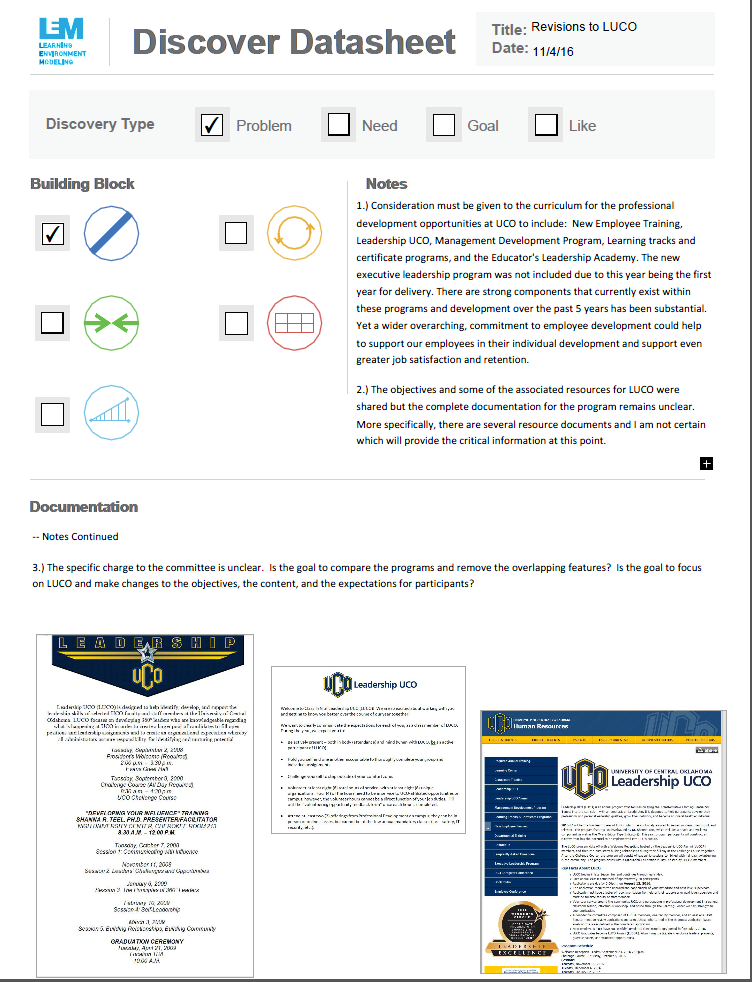
The first datasheet represents the problems [challenges].  


The second datasheet represents the Need.


The third datasheet represents the Goal.


Identifying a Learning Environment to Apply LEDx


I use the LEDx framework to work with a committee tasked with revising the LUCO program.  This program has been in existence for fourteen years and it is a highly regarded leadership experience for faculty and staff at UCO.  I participated in the program in 2007 and most of my employees have enjoyed the opportunity as well.  I was asked to join the revision committee and following the first meeting, I realized the project would be a great experience for my ILED assignment in course three/module 4. 

To initiate the project, I will work with Fran Petties and Ryan Kolb as they provide the primary leadership for LUCO.  The LEDx framework will help me identify needs, challenges and goals in the discovery and understand stages.  I will use the envision stage to share a model of the prospective changes with the group.  I anticipate LEDx helping to reduce time and improve the focus of the group.  In the end, Fran and Ryan will have a model to use in the build stage to make the changes needed for LUCO.

Wednesday, November 2, 2016

Empathy Research with Discover Datasheets

I met with one of my employees in the CeCE Video Studio.  He will soon become a one man show [at least temporarily].  This learning environment will undergo many changes over the next few weeks and it fits very well with the goals of this assignment.  My observations included the obvious set designs in three rooms, the meeting room, and the less obvious but very important missing piece.  I noted the missing piece to be a lack of process documentation and resources for clients using the studio for video production.  This leads to frustration and time consuming tasks for the staff and confusion for the client.  My discovery datasheets include one for the need, a noted problem and a goal. The datasheets helped me identify the next step to reorganization.

Problem:


Need:
Goal:

Monday, October 31, 2016

Client Empathy Discover Datasheet

Watching Dona handle phone calls, walk-in requests for help, emails, and mounds of paperwork is impressive.  As I observed her for the empathy stage, I paid careful attention to what her goals were to begin the day, how she dealt with "needs" and how she demonstrated accomplishments or marked projects "on-going" for future reference.  The following discover datasheets focus on the discovery types of need, information and goals.


Friday, October 14, 2016

Getting Focused - First Focus Board


I am working with team members to develop the CeCE Video Studio.  The studio is a self-contained environment that provides the potential for creative video solutions for the UCO blended learning community.  The level of effective development of the space will determine the success.

This exercise helped me to isolate many of the specific needs that should be thoroughly addressed.  It is a good way to communicate the needs and responsibilities for all included in the project.

Wednesday, October 5, 2016

Discover Interview Reflections


I laughed out loud when I read the instructions for this activity because only minutes before I had to step back from a situation and pull out the ole empathy toolbox.  Working in education and with technology means I encounter those that teach very well but know very little about technology, those that teach well….ok but are superstars with technology and those that manage a good balance with both.   It can be a challenge to meet the needs of all levels.  Today I find myself looking for the ways to identify and develop empathy with a professor that is technically challenged in a way that results in a very poor outcome for learners.  

My toolbox:

Walk a Mile in Her Shoes – Consider how long she has taught and how much technology has changed?  Think about the added stress of not knowing how to use technology coupled with embarrassment of asking for help.

Think about the motive for waiting so long to ask for help – What might discourage her from asking for help earlier?

Focus on compassion – Make an intentional effort to respond to her with compassion and seek understanding.

Remove judgments – Discard memories of past experiences and focus on understanding the current situation.

Seek perspectives from others – Check my perceptions of the situation with someone else.

These efforts combine to create empathy and give me a renewed energy to help her resolve the technical challenges both to her benefit and most importantly, for her students.